14.4.12

Foxy friends

Fox fur - perfect camouflage for a patch of strawberries... if they're ripe.


This handsome guy is in our garden almost every day. Sometimes he curls up in the herb bed, but this is his favourite spot - in the strawberry patch. We've grown very fond of him, but at some point we'll have to try and persuade him to sleep somewhere else. He leaves behind a distinct smell, and I don't really fancy fox flavoured strawberries.

And off he goes...
I'm going to send my sighting in to Channel 4's new Foxes Live project (and not just because the company I work for are making the series - I'd love to know more about what our urban foxes get up to).


8.4.12

A new fence - before and after

Last year we did a lot of work to the inside of our little council flat, and having done that, we're finally starting to do a bit more in the garden. First up a brand new fence/screen for our little area of decking.

This is what it looked like originally:

The Old Fence. Scruffy.


I'd cobbled it together from old scraps of wood and a scaffolding pole. It had it's charm, but the honeysuckle was getting way too big for it, and it didn't really give us any privacy from the block of flats behind us.

So we bought three sturdy 2x3 inch wood poles, and sunk them into the ground, using postcrete at the bottom to give them more stability. I'd never used postcrete before, but it seemed pretty simple - just pour it in the hole the pole sits in and add water. The first pole is a little wobbly - but the other two are steady as a rock. I only put them down about a foot, as I didn't want to disturb the border behind them too much.

Old fence still there, posts concreted in position.
Next I cut to length lots of very rough 2x1 inch strips, and screwed them into the posts on either side alternately. I left them slightly more than 2 inches apart so you can see a bit through the screen. This is the first side going up:

Rear side on - with the old fence still in place.


And then the rear side, and a beam at the top:

The (nearly) finished fence. The old honeysuckle is still there - just draped on the border in front.


The real labour of love was cutting off the honeysuckle from the old screen. I was all for hacking it to the ground, but the other gardener has a lot more patience than me, so it survived.

Now all we have to do is paint the whole thing with protective wood stain to protect the wood, and then add wires across from the top to the side of the house to make a sort of pergola. It was pretty easy to put up - but took me three weekends in total.

From the other side it looks enormous. Means we're totally hidden though now - which is exactly what we wanted.


29.3.12

2011 Roundup


Before we get too far into 2012 I thought I'd share last season's veg-growing successes and failures in one giant wordy post. 

On the whole the summer crops weren't a huge success, but we did better at planting winter crops this year, and made better use of our confined space by making sure as soon as one crop finished, we put another one in its place. It wasn't all roses though...

26.2.12

Snow Day


If there's one thing the internet needs it's more pictures of cats. So here you have it. A picture of one of ours. He likes the snow - I think he knows that it sets off the white in his coat and whiskers. 

It's been a mostly mild winter, so this cold patch was very welcome. Kills a few bugs, and makes it feel like there's actually been a season between Autumn and Spring. 


23.11.11

An Ode to Oudolf


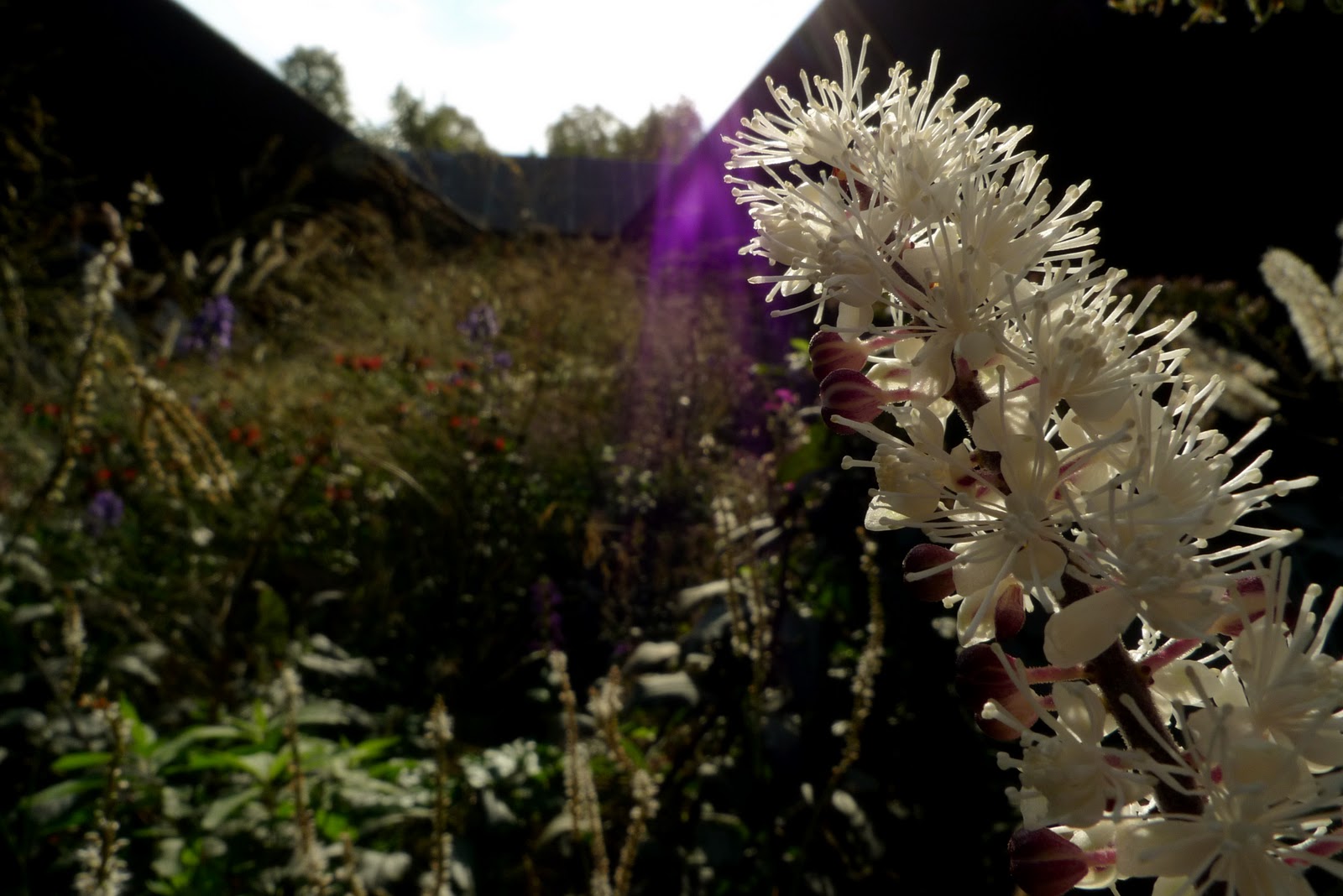
Is it art? Who knows, but it's a beautiful bit of planting in a remarkable setting. Piet Oudolf's installation at the Serpantine Gallery in Hyde Park is in the middle of a sci-fi style matt black obelisk. You have to stumble through a series of dark corridors before you emerge blinking into the central space.

I can only imagine how beautiful it is in the early morning when no-one is there. but sadly on a sunny Saturday in central London it was packed.

No matter. The planting looked great, even though autumn is upon us. I found myself going back into the corridors to enjoy the views framed by the doorways. In the central space, I found the dark overhanging building a bit glowering and oppressive.

Still, coming face to face with a planting designed by one of your gardening heroes doesn't happen every day!

[By the way, this is a belated post from early October... which explains why it is so warm and sunny in these photos!]


30.8.11

A rather unusual roof garden


The perceptive and knowledgeable Londoner might look at the above photo and notice that it looks like this was taken from the top of the concrete jungle that is the Southbank Centre. And yet it looks like it's a lush and green park.

There's a reason for that.

The Queen Elizabeth Hall - part of the Southbank complex, next to the Royal Festival Hall - have grassed over their roof, planted a wildflower meadow, several trees, lots of turf, and raised beds with lots of veg in. It's an island of green in an ocean of concrete, with a view of the Thames too. I bet it's a bugger to water, but as you can see it's proving pretty popular.

It's free to visit, and they have a bar that serves a mean cocktail. If the weather warms up before it closes on the 4th September I'm definitely going back.

Link here.


15.8.11

Hiatus

I've been away. Filming in the stink and heat of Florida and Alabama. Battling mosquitoes the size of hummingbirds

I've come back to a garden that's totally different to the one I left, such has been the rain and the growth. It's great to be back home. I've so much to say, but very little time! More posts to come shortly...


8.7.11

The Beauty of Borage

Borago Officinalis

Yes it's a weed. Yes it's a thug. But up close isn't it amazing? In health food shops they label Borage oil as 'Starflower Oil' instead. A bit moon-eyed, but you can see why. We've got too much of it, but it brings in the bees like nothing else. It's been flowering here for a good few weeks and won't stop until autumn. I grow it as a companion plant. It seems to be good with courgettes, as both have hairy leaves, but I've found that the hairs on the borage leaves can damage smooth leaved plants. So it's not the ideal companion plant really, but I love it nonetheless.


4.7.11

New Arrival

Japanese Wineberry - Rubus phoenicolasius
A gift from an old friend arrived this week. I've been lusting after them for ages, and I have high hopes for them. It's a pair of Japanese Wineberry plants. They are handsome already, but will grow much bigger I hope, up to 3m tall. Their fruits are apparently a bit like raspberries, but encased in the bizarre little furry pods below right up until they are ready to eat, when they burst open to reveal the fruit.  I'll have to let you know how they get on. I'm told they are very easy to grow, fruit abundantly, and better still taste delicious. They also don't show up in the shops - which I always think is a big factor in choosing which plants to grow yourself.
Now, where to put them... this time of year there's not a lot of space!

More Japanese Wineberry - the unripe fruit

25.6.11

A series of unfortunate events

I think mother nature has it in for us here at the clay garden at the moment. Here's why:

Blight:

Our potatoes aren't ready to pull, but they have black spots all over them and are looking very sorry for themselves. The only thing to do now is cut down all the foliage and burn it. We may salvage some spuds, we may not. I think that means growing tomatoes is out this year too as they'll get blight for sure. I should have sprayed the spuds with copper sulphate earlier this year but thought I could get away with it because of the dry weather. More fool me...


Cucumber Mosaic virus:

We have a cucumber mosaic virus conundrum. Our courgette leaves are turning bright yellow. Apparently this could be a sign of the dreaded cucumber mosaic virus. Or it might be just normal for yellow courgettes. At the moment we just can't tell. We've got several different species of courgettes. The yellow ones have the yellowest leaves, but even the green climbing courgettes are yellowing a little. If we do have the virus we should cut the plants down now and burn them. If we don't then we're due a bumper crop. A trawl of online forums gives mixed advice and I just don't know what to do. As the plants look healthy for the moment I've left them to see if they stay that way. If they start looking unhappy they're for the chop. I had such high hopes for the climbing courgettes as a good small garden space saver.

UPDATE: I have put out a call for help on Twitter - any advice appreciated as to what to do!!!


Plague:

Of slugs. They are everywhere thanks to a very damp June, and have succeeded in totally massacring every climbing bean we put in, as well as the entire first sowing of peas. I'm going to nematode them this evening but deep down I know even biological warfare won't defeat them. Bah.

Oh, and I've been ill. So that proves it. Let's hope July is better. Any advice on the cucumber mosaic virus appreciated!